

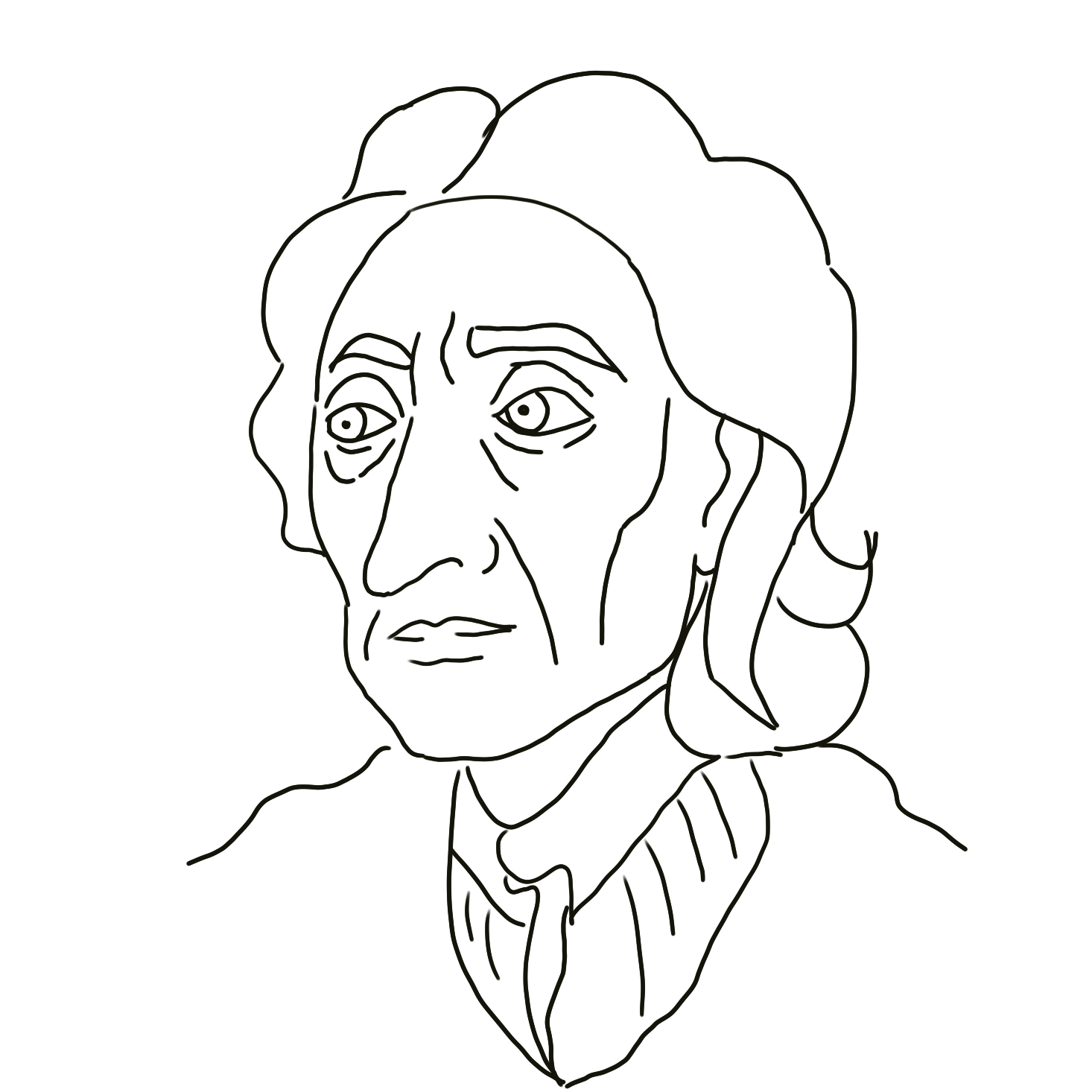
 Who was John Locke?
John Locke (1632–1704) was born in Wrington during a time of political upheaval. His father fought in the English Civil War of 1642 under Colonel Alexander Popham, who later supported the young Locke by helping him gain admission to the prestigious Westminster School in London. In this tolerant environment, Locke learned that most issues have multiple perspectives. After five years, he earned a scholarship to Oxford University. At Oxford, Locke initially studied classical literature, but his interests soon expanded. He worked closely with Thomas Willis and other progressive physicians, eventually becoming a skilled doctor himself. Around the same time, he was influenced by Robert Boyle (1627–1691), a pioneer of experimental science and founder of Boyle’s law, which states that the volume of a gas varies inversely with pressure. With Boyle’s help, Locke established a small laboratory in Oxford, contributing to the development of modern chemistry. Locke also read the works of Descartes, which strengthened his belief that knowledge should not be accepted based solely on authority.
By his mid-thirties, Locke had developed expertise in classical studies, medicine, science, and diplomacy. In 1666, he met Sir Anthony Ashley Cooper (1621–1683), a powerful political figure and favorite of King Charles II, who later became the Earl of Shaftesbury. Their meeting led to a close friendship, based on shared beliefs in religious tolerance and limited government. Locke became Cooper’s personal physician and moved to London. When Cooper developed a life-threatening cyst, Locke consulted the renowned physician Thomas Sydenham and arranged a risky but successful operation. After this, Locke became not only Cooper’s doctor but also a trusted political advisor. Cooper later became one of the leading figures behind the development of the Carolina territory in America, and Locke played an important role in drafting its fundamental constitution. This document promoted limited religious tolerance and restricted democratic voting rights.
Locke also became a member of the Royal Society in 1668, joining other leading scientists like Boyle. During this time, he began working on a major philosophical project: investigating the nature and limits of human knowledge. He spent nineteen years developing these ideas, which culminated in his most famous work, Essay Concerning Human Understanding. In 1679, a political crisis arose over the succession to the English throne. Shaftesbury opposed the idea of the Catholic James II becoming king, leading to conflict with Charles II. Shaftesbury was arrested and imprisoned in the Tower of London, and both he and Locke eventually fled to the Netherlands. While in exile, Locke continued working on his major texts, including Essay Concerning Human Understanding and Two Treatises of Government. Meanwhile, the political situation in England changed. After Charles II’s death, James II briefly became king but was soon replaced by his Protestant daughter Mary and her husband, William of Orange. Following this shift, Locke returned to England.
What did John Locke describe in An Essay Concerning Human Understanding?
John Locke argued in An Essay Concerning Human Understanding that all human knowledge is derived from experience. He was influenced by the scientific achievements of Robert Boyle, Christiaan Huygens, and Isaac Newton, whose observational and inductive methods he regarded as the ideal model for how the human mind should function. Locke proposed that the human mind operates according to an inductive model, meaning that knowledge develops through observation of the external world. He viewed the mind as largely passive and receptive, with one of its primary functions being the reception of sensory input. He strongly disagreed with René Descartes, who claimed that humans possess innate ideas. Locke argued that such ideas cannot be innate because they are not present in young children or individuals with limited cognitive development. Instead, he supported the concept of the tabula rasa introduced by Aristotle, which describes the mind as a “blank slate” at birth. According to Locke, knowledge originates from two types of experience:
– Sensation – information received from the external world through the senses
– Reflection – internal observation of the mind’s own processes
These experiences produce ideas, which form both immediate awareness and stored memories. Early experiences generate simple ideas, such as redness, loudness, coldness, or sweetness. Over time, the mind actively combines these simple ideas into complex ideas. For example, the idea of an apple consists of redness, roundness, and sweetness. Locke emphasized that all complex ideas must be grounded in prior sensory experience. Without this empirical foundation, meaningful or “true” knowledge cannot exist.
What kinds of knowledge did Locke distinguish?
Locke defined knowledge as “the perception of the agreement or disagreement between ideas.” He identified three types of knowledge:
– Intuitive knowledge: Immediate and self-evident understanding (e.g., recognizing the difference between black and white).
– Demonstrative knowledge: Knowledge gained through logical reasoning, where each step is intuitively certain, though the full argument requires multiple steps.
– Sensitive knowledge: Knowledge derived from sensory experience. This forms the basis of most human knowledge about the external world.
Locke also introduced the concept of the association of ideas, referring to how ideas become linked in the mind. He distinguished between:
– Natural associations: Based on real connections in the world (e.g., the properties of objects or scientific laws)
– Accidental associations: Formed through habit, culture, or coincidence
Only natural associations, according to Locke, lead to reliable knowledge. Like Galileo Galilei and Descartes, Locke distinguished between:
– Primary qualities: Objective properties such as shape, size, solidity, and motion, which exist in objects themselves
– Secondary qualities: Subjective properties such as color, sound, taste, and smell, which arise from the interaction between objects and our senses.
Locke considered primary qualities to be more fundamental and reliable than secondary qualities.
What is the influence of Locke?
The central message of Locke’s work is that all knowledge originates from experience, but no individual can achieve complete knowledge of the world. This idea aligned with the political climate in Britain at the time, encouraging intellectual humility and tolerance. In his later work, Two Treatises of Government (1690), Locke applied his ideas to politics. Building on the social contract theory of Thomas Hobbes, he presented a more optimistic view of human nature. While Hobbes saw humans as naturally selfish and aggressive, Locke believed people are capable of reason and cooperation. According to Locke:
– Governments exist through a social contract with the people
– Individuals give up some freedoms in exchange for protection and order
– If a government fails to protect its citizens, people have the right to resist or replace it
In 1693, Locke also published a work on education, advocating learning through experience and observation. He continued revising his Essay throughout his life, producing multiple editions.
Source: Bron: Fancher, R. E., & Rutherford, A. (2017). Pioneers of Psychology: A History (5th ed.). W.W. Norton And Company