

Herman Helmholtz (1821-1894) was born in a small town near Berlin. His father with interest in Kantian philosophy, encouraged Hermann’s enthusiasm for science. Physics became Hermann’s passion. Around the age of 17 Helmholtz applied to the government program allowing him study medicine and become army surgeon. During his studies he came across Johannes Müller, who was a major promotor of the law of specific nerve energies. He also became friends with a brilliant group of fellow students, including Emil du Bois-Reymond (1818–1896), who would later collaborate with Helmholtz in establishing the physical nature of the nerve impulse; and Ernst Brücke, who would eventually become the favorite teacher of Sigmund Freud. Müller frequently used Helmholtz concepts from physics to account for physiological processes. Even with his respect for physics, Müller still clung to an old physiological doctrine known as vitalism, according to which all living organisms have within themselves a nonphysical “life force” that is essential for them to be alive and that is not analyzable by scientific methods. This view was not quite as extreme as the ancient Greek notion of the psyche. Helmholtz and his friends refused to accept this implicit limitation on science. They rejected vitalism and adopted the doctrine of physiological mechanism, declaring all physiological processes to be potentially understandable in terms of ordinary physical and chemical principles. As a result they revolutionized physiology.
The triumph of physiological mechanism
At 21, Helmholtz received his medical degree and began his 8 year military obligation. He found his duties tedious but scarcely all-consuming of his time, so he built a small physiological laboratory in his barracks where he studied metabolic processes in frogs. His experiments demonstrated that the amount of energy and heat generated by frog muscles was roughly equal to the amount of energy released by the oxidation of the food it consumed. He showed that ordinary chemical reactions were capable of producing all the physical activity and heat generated by a living organism. He took to a related idea that was being debated by physicists at the time: the law of conservation of energy. According to this then-hypothetical notion, all the kinds of forces in the universe—heat, light, gravity, magnetism, and so on—are potentially interchangeable forms of a single huge but quantitatively fixed reservoir of energy. Energy can be transformed from one state to another, but never created or destroyed by any physical process. The total amount of energy in the universe is constant and conserved.
Helmholtz approached the conservation of energy hypothesis in a unique way. He argued that a perpetual-motion machine, if it could be successfully built, would necessarily violate the conservation of energy principle. Any machine with moving parts that touch one another must inevitably generate heat by friction, which would represent a loss of total energy in the system. According to the conservation principle, motion could never be “perpetual” but had to be maintained by the constant input of new energy or fuel from the outside, to compensate for the energy lost as heat. Helmholtz proceeded to show that a successful, conservation-violating perpetual-motion machine had not and could not be built. Helmholtz concluded that all organic processes had also seemed governed by the conservation of energy, thereby implying that the range of this physical principle extended into physiology.
The Prussian government shortened Helmholtz’s military obligation and in 1849 named him professor of physiology at Kant’s old university. There he conducted a study with major implications for both neurology and psychology, concerning the speed of the nerve signal (speed of light). During the 1840s, however, Helmholtz’s mechanist friend du Bois-Reymond had studied the chemical structure of nerve fibers and speculated that the nerve signal might be an electrochemical wave traveling along the nerve at a slower rate than anyone had imagined. Helmholtz devised an instrument using the degree of deflection of a galvanometer needle to record smaller fractions of seconds than were detectable by existing timepieces. He devised an apparatus in which an electrode could apply current to various points on the frog leg, and the resulting foot twitch would turn the electricity off. Using these measures he calculated that the nerve signal traveled at a speed of about 57 miles (92 kilometers) per hour. Helmholtz next turned to human subjects and estimated nerve signal speed in the human leg was faster than in a frog’s but still definitely finite and measurable. This was one of the earliest recorded studies of variations in human reaction time: the measured time that elapses between the presentation of a stimulus and the performance of a specified response.
Helmholtz on human vision
Helmholtz began his analysis of vision by dividing the subject into:
– Primarily physical
– Primarily physiological
– Primarily psychological
Physical studies regarded the eye as an optical instrument, examining the processes by which light from the external world comes to be focused into an image on the retina. The physiological analyses concerned the problem of how an image on the retina conveys signals to the brain that result in conscious sensations of light. Psychological analysis followed the process a step further, asking how sensations of light become converted into meaningful perceptions of discrete objects and events. Helmholtz’s distinction between sensations and perceptions bears elaboration. Sensations are the “raw elements” of conscious experience, requiring no learning or prior experience. Perceptions, by contrast, are the meaningful interpretations of sensations. For Helmholtz, the conversion of an image on the retina of the eye into conscious sensations of light and color was a physiological process, carried out by neurological mechanisms between the eye and the brain. The further conversion of sensations into perceptions was a psychological process involving activities in the brain, but also dependent on the learning and experience of the individual.
Physical properties of the eye
Helmholtz’s physical analysis described the eye as if it were a manufactured optical instrument, such as a microscope or camera. In a camera, the images of nearby or distant objects can be brought into sharp focus by altering the distance between the lens and recording medium. The eye achieves the same end, but by a different mechanism in the lens itself known as accommodation: the lens assumes a relatively flat shape for sharply focusing distant objects on the retina, and it bulges in the middle to focus nearby objects. Helmholtz also observed, however, that virtually all of the eye’s physical features have “defects” or imperfections that would be considered unacceptable in a high-quality camera. The eye’s field of maximum sharpness is very small, for example, consisting only of that part of the image that falls on the fovea, a tiny section of the retina. Helmholtz observed other defects in the eye’s physical features. For example, colors are imperfectly reproduced on the retina, because the fluid in the eyeball is not perfectly colorless and because the lens refracts the relatively longer rays of red light less than the shorter rays at the blue-violet end of the spectrum. A common visual distortion known as astigmatism results from the imperfect alignment of refractive surfaces in the eyes. Perhaps the most dramatic defect of all is the blind spot, a small part of the retina where the optic nerve exits and therefore it contains no light-sensitive cells. For Helmholtz, these visual defects had philosophical as well as practical significance, supporting what he regarded as a Kantian interpretation of experience.
The neurophysiology of color vision
A century and a half before Helmholtz’s birth, Isaac Newton discovered that the “white” light from the sun is more complicated than it seems. He observed the light to emerge on the right as the elongated, multicolored band known as the solar spectrum. When sunlight passes through a prism, shorter waves become more broken than longer ones. Experiments with mixing colours show that the true situation is more complex, also show that the visual sense sometimes responds to mixes of wavelengths. There are certain pairs of colors— such as a particular red mixed with a certain blue-green, or a yellow when mixed with blue-violet—that create a sensation of white light indistinguishable from full sunlight. These white-producing pairs are referred to as complementary colors.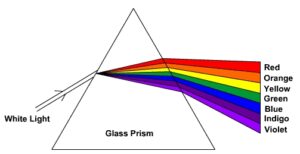 Helmholtz theorized that the retina contains three different kinds of light sensitive receptor cells. Nerves attached to the receptor cells presumably transmit messages to the brain whenever they are stimulated. Here was a refinement of Müller’s law of specific nerve energies, suggesting that individual nerves transmit sensory messages not only of a specific kind (visual, auditory, tactile, and so on) but also of a specific quality (red, green, or blue-violet). Helmholtz acknowledged that the English scientist Thomas Young had suggested a similar idea in 1802, so the name Young-Helmholtz trichromatic theory is commonly used for it.
Visual perception
When Helmholtz turned his attention from visual sensation to perception—from physiology to psychology—he agreed only partly with Kant’s point of view. He recognized that as sensations are interpreted and given meaning by the perceptual process, they undergo further transformations worthy of a Kantian “mind.” Sometimes the mind imposes features on its perceptions that contradict the raw sensations that give rise to them, as in optical illusions. Kant’s theory implied that spatial perception was mainly determined by innate intuitions and categories. Helmholtz, while regarding the processes of sensation as innate, gave greater emphasis to the role of experience and learning in perception. The question separating empiricist from nativist—Helmholtz from Kant—was not whether any perceptual processes were acquired through experience, but how many and to what extent.
One classic series of experiments demonstrated how spatial perception could be altered by experience. Helmholtz fitted subjects with spectacles that systematically distorted the visual field by shifting the images of objects several degrees to the right of their normal locations. When subjects were asked to look at an object, then close their eyes and reach out to touch it, their first responses were invariably to the right—toward the apparent rather than the real position. But if they were given a few minutes to handle objects while looking at them through the glasses, something Helmholtz called perceptual adaptation occurred. At first the subjects had to instruct themselves consciously to place their hands to the left of the apparent objects they saw, but soon this action became natural, automatic, and unconscious. Helmholtz theorized that perceptual adaptation and other perceptual phenomena result from a process he called unconscious inference. Visual experience— such as the manipulation of objects while wearing distorting spectacles—might lead to the unconscious adoption of certain rules that operate like the major premises in logical syllogisms. The difference between perception and syllogistic reasoning lies in the fact that perception occurs instantly and effortlessly, while the working out of a syllogism may be laborious and time consuming.
Helmholtz’s legacy
Although best known as a physicist, Helmholtz was one of psychology’s most important pioneers for two major achievements. First, he helped show how the neurological processes underlying mental functions, previously thought to be not directly observable or measurable, could be subject to rigorous laboratory experimentation. Second, he helped develop a scientific conception of the Kantian “mind” with his integrated physical, physiological, and psychological studies of vision and hearing. Many of Helmholtz’s ideas and theories are still accepted today, much as he originally presented them. The trichromatic theory of color vision has been amply confirmed by modern research.
Source: Fancher, R. E., & Rutherford, A. (2017). Pioneers of Psychology: A History (5th ed.). W.W. Norton And Company